



Metal Detectors for Food Processing: How They Work, What They Detect & How to Choose
What happens when a metal fragment enters your production line undetected? The consequences—recalls, regulatory fines, and irreversible reputational damage—can be severe. In today's competitive food processing environment, metal detection is not simply a quality checkpoint; it is a critical line of defense.
Whether you process bakery goods, fresh produce, or granular ingredients, understanding how metal detectors for the food industry function is essential for maintaining a secure production line. This guide explores the technology behind metal detectors for food processing, helping manufacturers choose the right equipment to meet HACCP standards and protect their brand reputation.
The Critical Role of Metal Detection in Food Safety
Before diving into the mechanics, it is important to understand why leading processors invest in metal detectors for food industry compliance and consumer safety.
Preventing Contamination
Metal detection systems scan for physical contaminants—such as broken blades, needles, or loose bolts—that can enter food products during processing. Catching these fragments before products reach consumers is essential for both safety and brand integrity.
Versatile Inspection Across Product Types
For comprehensive safety, many facilities integrate food industrial X-ray inspection systems alongside metal detectors to identify non-metal foreign objects such as glass, stones, or high-density plastics. Together, these systems deliver a comprehensive, multi-layered approach to foreign object detection.
Regulatory Compliance
Automated detection and continuous monitoring ensure your facility meets HACCP, BRCGS, and FSMA requirements, preventing costly product recalls and protecting your brand.
How Do Metal Detectors for Food Processing Work?
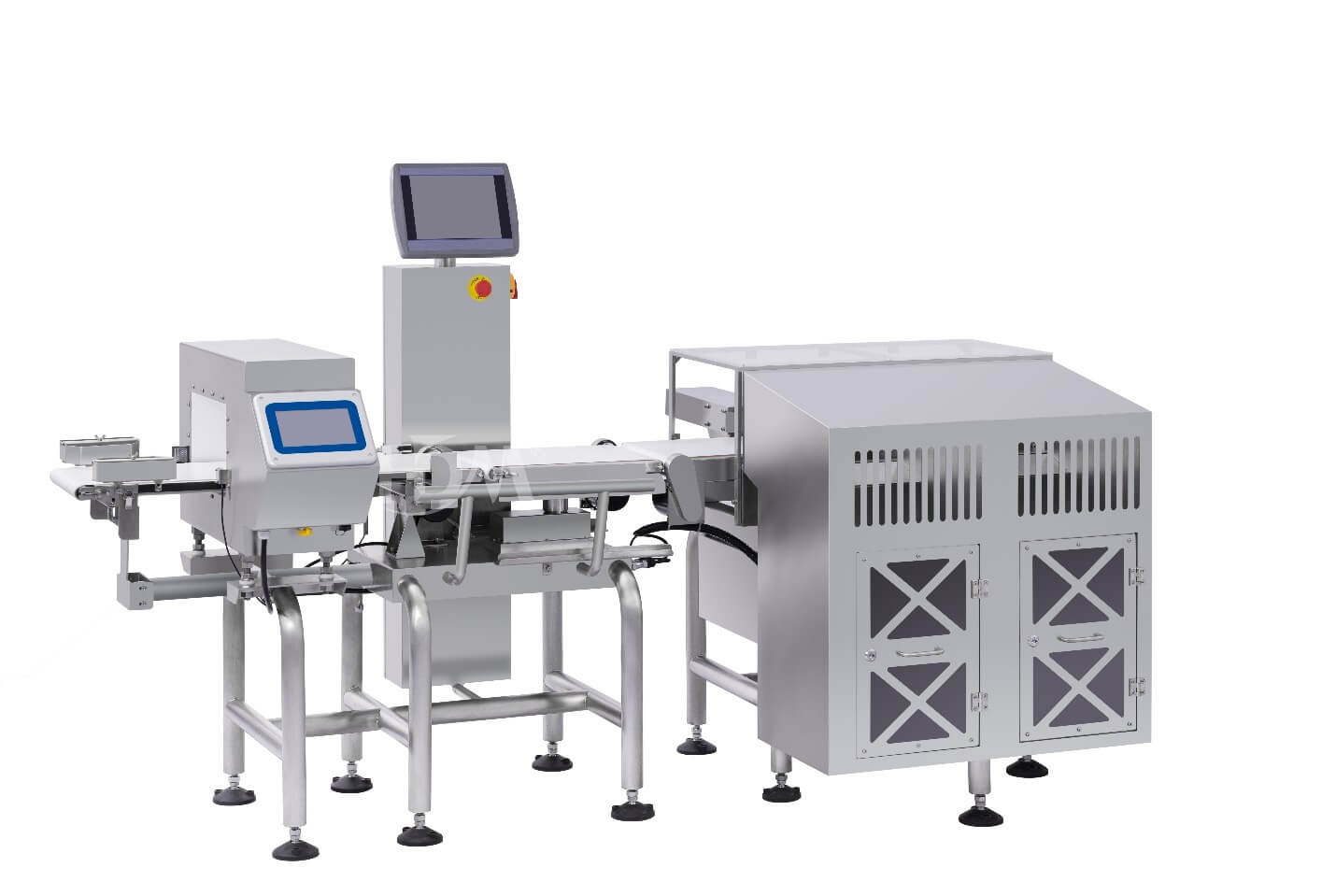
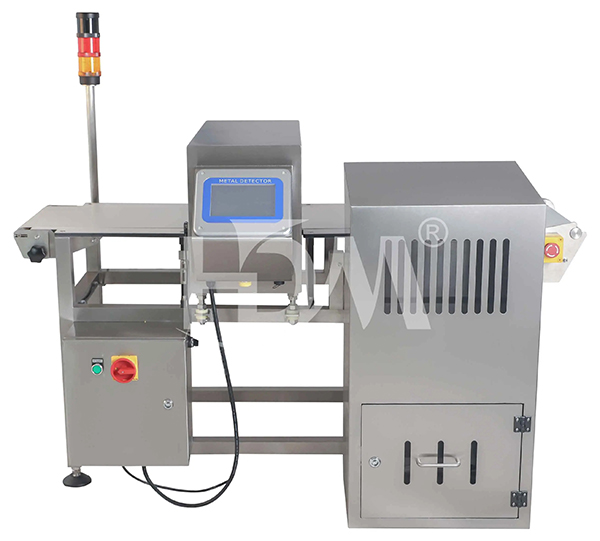
A metal detector for food processing operates on a precise combination of electromagnetic principles and signal-processing software. As the product moves along the conveyor belt, it passes through a transmitter coil that generates an electromagnetic field. This field interacts with any metal particles present in the product, causing them to produce their own detectable magnetic disturbance. Receiver coils instantly capture this change.
The detector's software then analyzes the signals to differentiate between harmless product variations and potentially harmful metal contaminants, triggering an immediate rejection response.
For facilities building a complete inspection line, checkweighers are often deployed alongside metal detectors to verify both product safety and weight compliance simultaneously.
Read more: Learn how checkweighing works.
What Types of Metals Can Food Metal Detectors Identify?
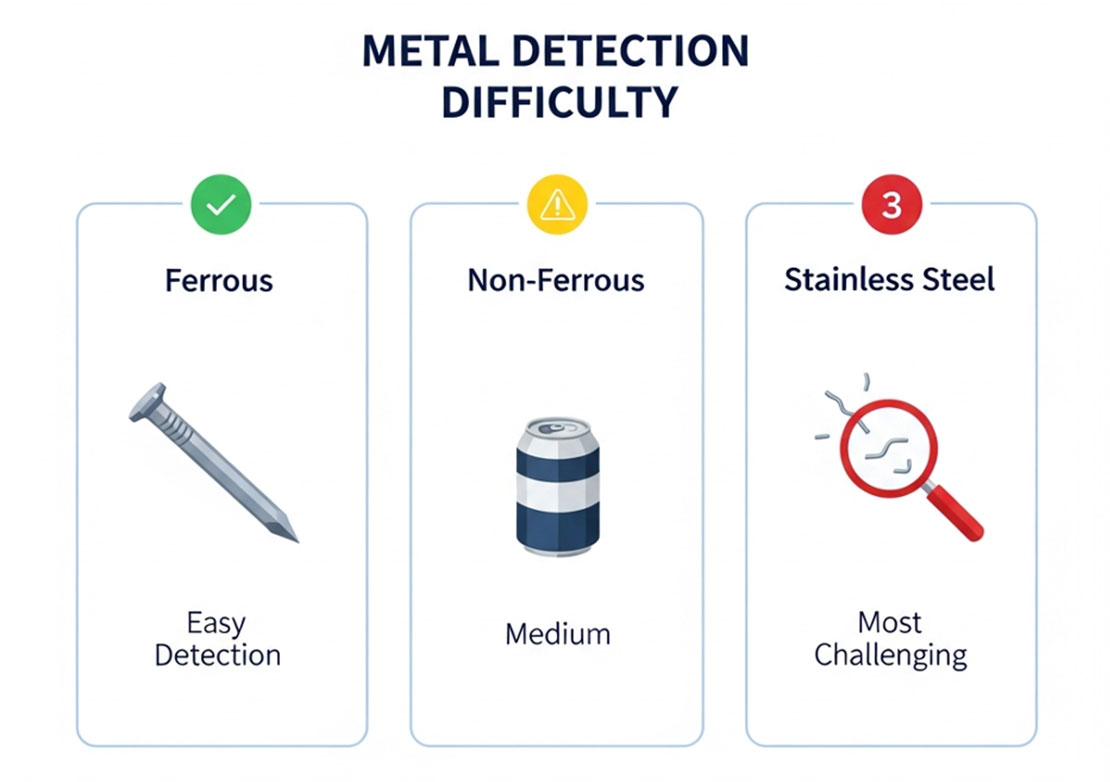
To achieve comprehensive food safety coverage, detection systems are calibrated to identify three primary metal groups:
- Ferrous: Magnetic materials and the easiest to detect (e.g., carbon steel, cast iron).
- Non-Ferrous: Non-magnetic but highly conductive metals (e.g., aluminum, copper, brass).
- Stainless Steel: The most challenging group due to low conductivity and non-magnetic properties. High Dream's food metal detectors utilize multi-frequency technology to capture even the smallest 316 stainless steel fragments—a common contaminant found in processing machinery.
Overcoming the “Product Effect” Challenge in Food Metal Detection
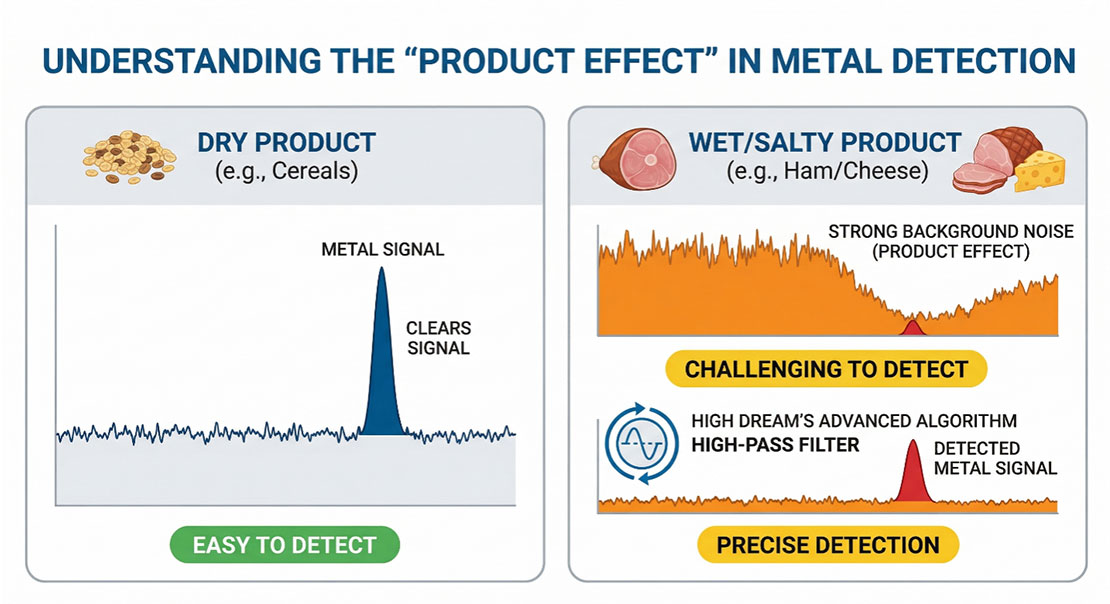
A common challenge in food metal detection is the “Product Effect,” where the food itself (such as high-salt meat or wet cheese) disrupts the electromagnetic field in ways that can resemble a metal signal.
- Dry Products: Items like cereals are non-conductive and can be easily scanned at high frequencies with minimal interference.
- Wet or High-Salinity Products: High moisture or salt content can produce false signals. High Dream’s advanced metal detectors feature frequency optimization technology to filter out the product’s own signal, maintaining high detection sensitivity while significantly reducing false rejects.
Choosing the Right Metal Detector for Food Industry Applications
Once a contaminant is identified, an automated rejection system is critical to prevent human error. Not all food metal detectors are built the same—High Dream provides specialized systems tailored to different product formats and conveying methods, ensuring the right fit for every application.
Conveyorized Systems
Our most versatile solution, ideal for final packaged goods, bakery items, or bulk raw materials transported on a flat or modular belt. These systems are engineered for high-speed lines and can be customized with integrated rejection mechanisms such as air blast or pusher arm rejecters.
Gravity Fall Systems for Powder and Granule Detection
Specifically designed for powders, seeds, and granules, gravity fall systems utilize a vertical pipe-style feeding method. Products fall through the aperture at high speed, enabling rapid inspection while maintaining a compact footprint on your production floor. This design is particularly effective for stainless steel detection in granular ingredients.
The following table summarizes recommended system types by application:
| Application | Recommended System Type | Key Feature |
| Packaged Snacks / Bakery | Conveyorized System | Multi-frequency scanning for foil-wrapped products |
| Powders / Granules | Gravity Fall System | Vertical pipe design for fast, space-saving inspection |
| Bulk Ingredients | Large Bag Conveyor | Heavy-duty design with high-sensitivity sensors |
Industry Success Stories: High Dream’s Real-World Impact
High Dream’s technology is tested and proven in the most demanding production environments. Here is how we help global food processors solve complex contamination challenges.
Case 1: Overcoming High Salinity in Frozen Seafood Processing
The Challenge: A large seafood exporter struggled with high false reject rates caused by the Product Effect from saltwater glaze, leading to significant yield loss and operational inefficiency.
Our Solution: High Dream implemented our Intelligent Learning Series with multi-frequency scanning, calibrated specifically for high-conductivity products.
The Result: The client achieved stable detection of non-ferrous particles as small as 1.0mm, reduced false rejects by 95%, and significantly increased overall production yield.
Meat and seafood processors face similar high-salinity contamination challenges. See how High Dream supports safe, efficient meat processing lines
Case 2: Space-Saving Integration for a High-Speed Bakery Line
The Challenge: A high-speed biscuit production line had extremely limited floor space for a required Critical Control Point (CCP) installation.
Our Solution: High Dream engineered an ultra-compact Conveyorized Metal Detector with an integrated high-speed Air Blast rejecter, custom-fitted to the available footprint.
The Result: The facility successfully met BRCGS audit requirements while reducing installation space requirements by 30%, preserving valuable floor space for other production equipment.
Operating a snack food production line? Explore how High Dream’s integrated weighing and packaging solutions complement your metal detection setup.
Read More: Snack Food Packaging Machines & Weighing Solutions
Case 3: High-Speed Stainless Steel Detection for Granular Ingredients
The Challenge: A seasoning manufacturer needed to detect fine metal fragments—including stainless steel—in a vertical gravity-fed production line without reducing throughput speed.
Our Solution: High Dream integrated a Gravity Fall Metal Detector with a rapid-acting divert valve, specifically engineered for continuous vertical pipe transport.
The Result: The system achieved industry-leading sensitivity for both ferrous and non-ferrous metals in continuous vertical flow, ensuring 100% safety compliance for export-grade products at full production speed.
Why Choose High Dream for Your Food Safety Metal Detection Needs?
With nearly two decades of experience, High Dream Intellectualized Machinery provides industry-leading food safety solutions. Our food metal detectors are engineered with precision and cutting-edge multi-frequency technology to ensure the highest level of detection accuracy across all product types—from dry snacks and bakery goods to high-moisture meat and seafood.
We don’t just supply equipment—we provide the technical expertise to help you select and implement the right metal detector for food processing environments of all kinds. Contact us today to find the right metal detector for food safety on your production line.
Explore More Food Processing Solutions from High Dream
Metal detection is just one part of a complete food processing line. High Dream offers a full range of intelligent weighing and packaging solutions designed to work alongside your safety systems—helping you achieve both compliance and efficiency at every stage of production.
-
Multihead Weighers for Fresh Produce:
Gentle, product-aware handling for delicate items such as long peppers, herb bunches, and irregular root vegetables.
View Fresh Produce Weighing Solutions -
High-Speed Confectionery Packaging Systems:
From gummies to wrapped sweets, our systems handle the full confectionery spectrum at up to 200 bags per minute.
View Confectionery Packaging Solutions -
30-Head Memory Weighing Series:
Scale up production without expanding your floor footprint—feed up to 5 packaging machines simultaneously from a single weighing system.
View 30-Head Weigher Series -
Combination Scale:
Precise multi-head weighing for a wide range of food products, designed to integrate seamlessly into high-speed production lines.
Read 12 Types of Combination Scales & Multihead Weighers: The Guide to Precision Weighing and Packaging -
Automatic Weighing and Packaging Machines:
An overview of automated weighing and packaging technologies to help you build a fully integrated production line.
Read the Full Guide about Automatic Weighing and Packaging Machines
Upgrade Your Line with Industry-Leading Metal Detection Technology
Protect your consumers, meet HACCP standards, and ensure 100% brand integrity with High Dream’s intelligent inspection solutions. Contact Our Specialists Today!