



How to Keep a Multihead Weigher Accurate: Maintenance, Cleaning and Calibration
A multihead weigher keeps its rated accuracy only with regular maintenance. Below is the routine we recommend to customers running our weighers, from daily checks to scheduled calibration.
Why Multihead Weigher Maintenance Matters
After long hours of operation, a multihead weigher collects product residue on its contact parts, its moving parts wear, and vibration and the plant environment take their toll. Any of these can shift weighing accuracy or make feeding less stable, often before a fault appears.
Clean contact parts also prevent cross-contamination between products, and a recorded cleaning and calibration routine helps you meet food safety requirements such as Hazard Analysis and Critical Control Points (HACCP) and International Organization for Standardization (ISO) standards. A well-maintained machine also extends the life of the frame and of precision components such as the load cells.
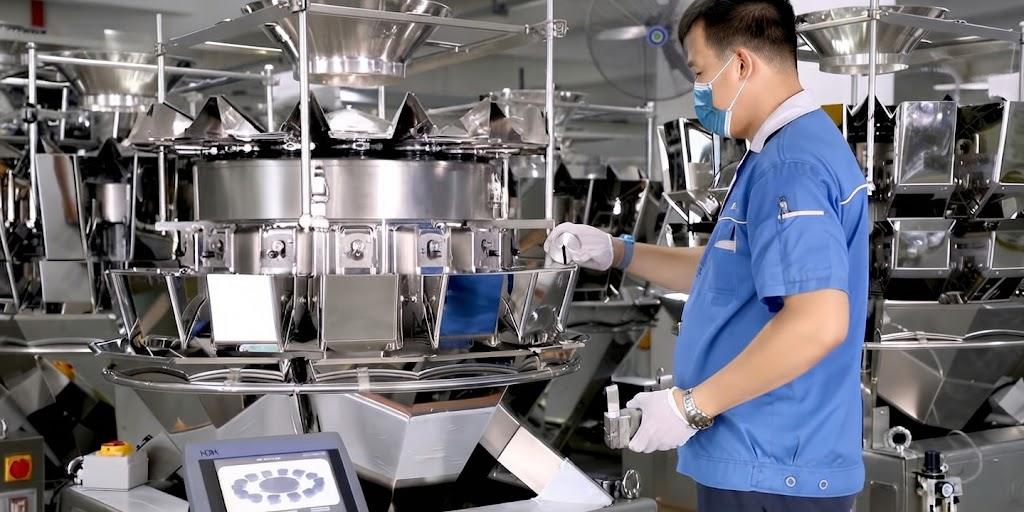
Removing a hopper for cleaning. Contact parts on our multihead weighers come off without tools
Safety Rules for Multihead Weigher Maintenance and Cleaning
Follow these rules whenever you clean or service a multihead weigher:
- Storage: Keep the weigher in a ventilated room at −10 °C to 40 °C, with relative humidity no higher than 90% and no corrosive gases in the air.
- Power: Switch off the power supply before any maintenance or cleaning.
- Disassembly: Except for the parts designed to be removed for cleaning, leave disassembly to maintenance staff.
- Weigh hopper hooks: Before each run, check the hook of every weigh hopper for foreign objects. A blocked hook stops the hopper from hanging freely, and its readings will be wrong.
- Cleaning agents: Use food-grade detergents and suitable cleaning tools. Avoid strong acids and alkalis, which corrode metal surfaces.
Daily Multihead Weigher Check
A few minutes of checks at the start of each shift will catch most problems before they affect production:
- Check the product path, from the feeders through the weigh hoppers to the discharge, for residue or jammed product.
- Open and close each hopper and confirm it moves smoothly and closes fully.
- While the machine runs, watch and listen for unusual noise, vibration or weight deviation on any head.
How long these checks take depends on the machine's design. Our weighers use tool-free removable components and smooth, round-cornered frames, so operators can reach and clear the contact parts quickly.
How to Clean a Multihead Weigher: Daily Cleaning and Lubrication
Clean every part of the multihead weigher that touches the product at the end of each day's production: the top cone, the linear feeder pans, the feed hoppers and the weigh hoppers. These parts come off without tools, and our washdown design makes them quicker to clean.
For lines that clean many parts at once, a washing wall is available as an option when you order. It gives you one place to wash and dry the hoppers and parts you have removed.
Two less frequent tasks keep the mechanism in good condition:
- Every 7 days: Lubricate the hopper joints with food-grade oil. In dusty environments, keep these points especially clean, because dust mixed with oil speeds up mechanical wear.
- Every 2 months: Clear the dust from inside the aluminum housing. The housing contains the mainboard, so leave this job to maintenance staff who are trained or experienced in opening it, not to regular line operators.
Cleaning keeps residue off the weigh hoppers; calibration then confirms that each load cell still reads correctly.
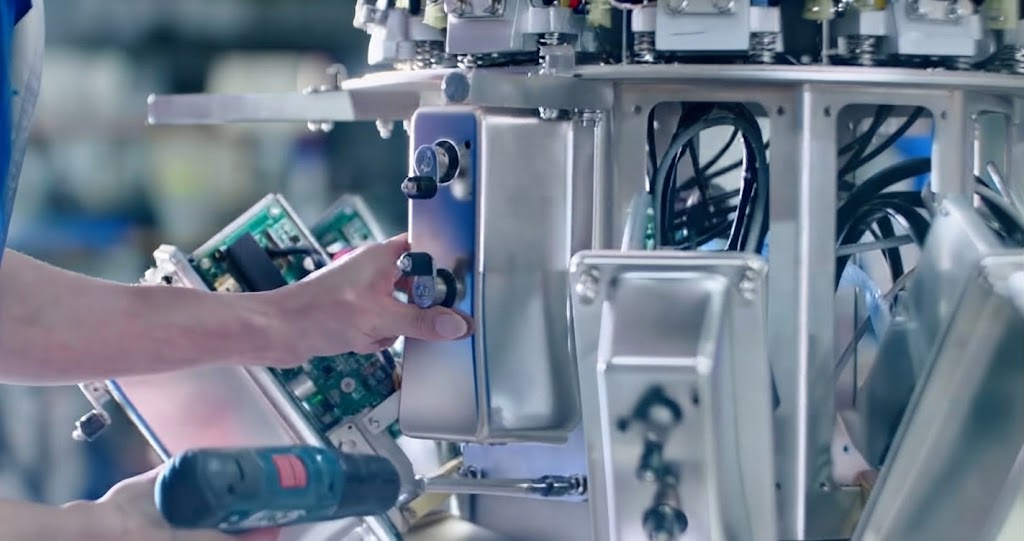
Opening the aluminum housing exposes the mainboard, so leave this step to trained maintenance staff. Daily cleaning only involves the tool-free hoppers and feeder pans.
Multihead Weigher Calibration: Keeping Weighing Accuracy Stable
In a multihead weigher, each weigh hopper hangs on its own load cell, and the controller builds every pack from those readings. If one load cell drifts, every combination that uses that head drifts with it. Residue, vibration, wear and temperature changes all move readings over time, so calibration has to be scheduled rather than left until a problem appears. Our guide to the multihead weigher working principle explains how the controller combines those readings into a target weight.
We recommend a zero-point check every day and a formal calibration every 6 to 12 months, depending on your production volume and the regulations that apply to your line.
Calibration uses standard test weights to confirm that each load cell reads correctly. We supply standard test weights with every machine, so you can run the check in your own plant. Our controllers support multi-level weight calibration, and the basic sequence is:
- Empty the weigh hopper you are calibrating.
- Zero that head.
- Place the standard test weight in the hopper.
- Compare the reading with the known weight and adjust if needed.
If a head's readings are still unstable after calibration, stop adjusting it and contact our service team.
Multihead Weigher After-Sales Support Beyond Daily Care
Beyond daily care, we provide the following after-sales support:
- One-year free warranty: Every machine comes with a one-year free warranty. After the warranty ends, we continue to provide repair and troubleshooting as a paid service.
- Operating manual: Each machine ships with an operating manual that includes basic troubleshooting steps.
- Spare parts and consumables: Contact our after-sales team when parts or consumables need replacing. With sales and service hubs across Europe and Asia, we can supply spare parts and technical support promptly.
- Installation and training: If you need it, we can send engineers to install and commission the machine and train your team, quoted separately.
If a part is wearing or a problem goes beyond the manual, contact our service team with your machine model and a short description of the issue.
Frequently Asked Questions
Customers most often ask us these three maintenance questions:
-
How often should a multihead weigher be cleaned?
Clean a multihead weigher's product-contact parts after each day's production. Lubricate the hopper joints every 7 days, and have trained maintenance staff clear the dust from inside the aluminum housing every 2 months. Lines that handle sticky or dusty products may need to clean the contact parts more often.
-
How often should a multihead weigher be calibrated?
A multihead weigher needs a zero-point check every day and a formal calibration every 6 to 12 months, depending on your production volume and the regulations that apply to your line.
-
What causes a multihead weigher to lose accuracy?
A multihead weigher usually loses accuracy because of product buildup, incorrect installation, vibration, or a problem with a load cell or the mechanism itself. Start by cleaning the machine and running a zero-point check. If one head's readings are still unstable, contact our service team.
Talk to Our Service Team
Regular cleaning, lubrication and calibration keep a multihead weigher at its rated accuracy. If you already run our weighers and need help with maintenance or spare parts, contact our service team. If you are planning a new line and want to know how a weigher will be cleaned and serviced, send us your requirements.