
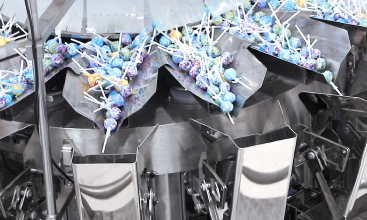



Multihead Weigher Working Principle: How the Weighing Cycle and Combination Calculation Work
A multihead weigher fills each pack by weighing several hoppers at once and releasing the combination closest to target. This guide explains the five-step weighing cycle, how the combination calculation works, and how head count and product type affect speed and accuracy.
A multihead weigher, also called a combination weigher, is an automatic weighing machine that fills each pack by combining portions from several separately weighed hoppers. The product is spread across the heads, every head is weighed at the same moment, and the controller releases the group of hoppers whose combined weight comes closest to the target without going under it.
The principle is the same on every machine; the differences lie in how each model handles the product. Two of our 10-head models cover the same 15–1000 g range, yet one is rated ±0.5–2 g and the other ±1–10 g, because the first is built for free-flowing product and the second for sticky product.
When you compare specification sheets, treat the head count as a guide to throughput and the hopper design as a guide to accuracy.
Main Components of a Multihead Weigher
A multihead weigher is built around a ring of identical weighing units, called heads, arranged under a central infeed. Each head has its own feeder, hoppers and load cell, and a single controller coordinates all of them.
| Component | What it does |
| Top cone | Receives product from the infeed conveyor or bucket elevator and spreads it outward to the feeders. On our large-volume models it rotates to spread leafy product evenly. |
| Level sensor | Watches the product level on the top cone and tells the elevator when to feed and when to stop. |
| Linear feeders | Vibrating pans, one per head, that carry product from the top cone into the feed hoppers. Amplitude and feed time set how much each head receives. |
| Feed hoppers | Hold the next portion above each weigh hopper, ready to drop as soon as it empties. |
| Weigh hoppers and load cells | Each weigh hopper hangs on its own load cell, which measures the portion inside it. |
| Memory hoppers (optional) | Hold portions that have been weighed but were not used in the last combination. |
| Stepper motors | Open and close each hopper gate with precise, repeatable timing. |
| Discharge chute and collecting hopper | Gather the selected portions and release them into the packaging machine. |
| Controller and touch screen | Runs the combination calculation and stores the settings for each product. Our weighers use a 10.4-inch color touch screen. |
Our weighers are built from food-grade 304 stainless steel, and our models rated IP66 under the Ingress Protection (IP) code are designed for rigorous washdown. Each of these parts comes in several versions, such as dimpled or plain hopper surfaces and different feeder designs, and the choice affects both speed and product handling.
How a Multihead Weigher Works: The Five Steps of the Weighing Cycle
Every multihead weigher repeats the same five-step cycle many times a minute. Product is spread out, fed into the hoppers, weighed, combined and discharged, and each emptied head refills while the next combination is being calculated. All our multihead weighers, from 6 heads to 30, follow this cycle.

The five steps of the weighing cycle. Steps 1, 2 and 5 move the product and depend on how it flows. Steps 3 and 4 weigh and calculate, and work the same way for every product.
Step 1: Infeed and Dispersion
Product arrives from a conveyor or bucket elevator and lands on the top cone, which vibrates to push it outward toward the linear feeders. No weighing happens at this stage. The aim is to spread the product evenly, because any section of the ring that runs short leaves its heads with nothing to weigh.
The level sensor keeps the supply steady by starting and stopping the elevator as the level on the cone falls and rises. This matters because if too much or too little product reaches the hoppers, their weights drift out of the range the controller works with, fewer combinations land near target, and both speed and accuracy drop.
Step 2: Linear Feeding
Each linear feeder moves product outward into its own feed hopper. The controller adjusts this step by setting each feeder's vibration amplitude and feed time, which together decide how much product lands in each hopper. A 14-head machine has fourteen feeders, each set separately, which is why commissioning a new product takes longer than most buyers expect.
Step 3: Weighing
As soon as a weigh hopper is empty, the feed hopper above it opens and drops the next portion in. The load cell under each weigh hopper measures its portion, so ten heads produce ten separate weights at the same moment. At this point nothing has been added together. The machine holds ten weighed portions, and the next step decides which of them go into the pack. That is what separates a combination weigher from an ordinary scale.
Step 4: Combination Calculation
The controller reads every weigh hopper at once and picks the group whose total comes closest to the target without falling below it. It then signals the packaging machine that a portion is ready. The next section shows how that choice is made.
Step 5: Discharge and Refill
When the packaging machine asks for product, stepper motors open the selected weigh hoppers. The portions fall through the discharge chute into the collecting hopper, or straight into the bag if no collecting hopper is fitted, and the weigher confirms the discharge so the packaging machine can seal the bag. The emptied weigh hoppers refill from the feed hoppers above them and rejoin the next combination.
Throughput is limited mainly by refill time. A head that is still filling cannot join the next combination, so anything that slows the refill slows the whole machine, however quickly the load cells settle. For how the weigher fits alongside the bag maker and inspection equipment, see our overview of automatic weighing and packaging machines.
How the Combination Calculation Finds the Closest Weight
The number of possible groups rises quickly with each head: 10 weigh hoppers give 1,023 combinations, and 14 give 16,383. With more candidates, the controller can usually find a group closer to the target, so less product is given away above the declared weight on each pack.
Take a 10-head machine with a 250 g target as an example, and suppose the ten weigh hoppers currently hold these portions (illustrative figures):
| Head | 1 | 2 | 3 | 4 | 5 | 6 | 7 | 8 | 9 | 10 |
| Weight (g) | 58.4 | 61.2 | 49.7 | 66.3 | 52.8 | 70.1 | 55.6 | 64.2 | 47.5 | 59.8 |
If you added the portions one after another until you passed the target, the way a single scale fills a bag, you would stop at head 5 with 288.4 g, which is 38.4 g over. The combination search instead finds heads 1, 2, 4 and 8: 58.4 + 61.2 + 66.3 + 64.2 = 250.1 g, only 0.1 g over. Only those four hoppers open. The other six keep their portions and go straight into the next search.
Multihead weighers were developed for exactly this kind of search. They first appeared in the 1970s, and early machines were used on certain vegetables. Produce shows the problem clearly: pieces vary so much in weight that nobody can hit a pack weight exactly by adding them one at a time, and swapping a small pepper for a large one until the scale reads right is slow and rarely precise. Picking the best group from many pre-weighed portions solves both problems at once.
Whether a controller evaluates every possible group or a bounded search of the most promising ones is a design decision. It is a fair question to put to us, and to any other supplier you are comparing.
Accuracy, Speed and Giveaway
Giveaway is the product you put in the bag above the declared weight. Reducing it is the main reason companies buy a multihead weigher. Some giveaway is unavoidable. Because step 4 selects a combination that meets the target without falling below it, the result is usually slightly over the target and rarely exactly on it.
Three factors increase giveaway: a coarser fill per head, because the smallest available increment is larger; fewer candidate combinations, which the next section covers under head count; and, most of all, product that does not leave the hopper cleanly, because the weight measured is no longer the weight that reaches the bag.
A headline speed figure only makes sense once you know how many discharge lanes it covers. Our Memory Hopper 30 Heads, for example, is rated at 300 weighments per minute (WPM), also listed as 5 × 60 WPM. Its 30 heads are divided into five independent weighing groups, each running at 60 WPM and each feeding its own packaging machine. The 300 is the total across all five lanes; if your line has one packaging machine, 60 WPM is the figure that applies to you.
Any speed specification needs the same care. A WPM figure means little without its test conditions: the product, the target weight and the tolerance. The same machine will not reach the same speed on 500 g of rice and on 150 g of shredded mozzarella. Because a weigher can only vouch for what it weighed, many lines add a checkweigher after the packaging machine to confirm what each finished pack actually contains. Our checkweighing guide explains how that final check works.
Keeping a Multihead Weigher Accurate
Rated accuracy assumes each load cell is reading from a true zero. Product residue in a weigh hopper, dust on the contact surfaces or a knock during cleaning all shift that baseline, which is why a daily zero-point check and a formal calibration every 6 to 12 months are standard practice. Our controllers support multi-level weight calibration and include a smart fault alarm that flags problems as they occur. The full schedule, from daily checks to annual service, is in our multihead weigher maintenance and calibration guide.
How the Number of Heads Affects Speed and Accuracy
In principle, more heads should mean a closer match, because each extra head roughly doubles the number of possible combinations. Published specifications show that the gain goes mainly into throughput. The 4.0G 10 Head runs 70 WPM and the 4.0G 14 Heads runs 110 WPM. Both are rated ±0.5–2 g, on the same 1.6 L hoppers, over the same 15–1000 g range.

Adding four heads to the same machine family raises throughput by 57% and leaves the stated accuracy band unchanged, while switching to a different product at the same head count widens that band roughly fivefold. Head counts available across the range run 6, 8, 10, 14, 16, 18, 20, 24 and 30; hopper volumes run from ≤1 L to ≤8 L, paired model by model.
Three published models show the pattern side by side:
| Model | Heads | Hopper | Speed | Stated accuracy | Weight range |
| 4.0G 10 Head | 10 | 1.6 L | 70 WPM | ±0.5–2 g | 15–1000 g |
| 4.0G 14 Heads | 14 | 1.6 L | 110 WPM | ±0.5–2 g | 15–1000 g |
| Anti-sticky 10 Heads | 10 | 1.5 L, scraping | 80 WPM | ±1–10 g | 15–1000 g |
The three Anti-sticky models follow the same pattern: 6 heads at 40 WPM, 8 at 60 and 10 at 80, all rated ±1–10 g. In both families, extra heads changed the speed and left the accuracy specification alone.
Going from 10 heads to 14 raises the number of candidate combinations from 1,023 to 16,383, and the machine uses those extra candidates to reach the target weight faster. Precision is set earlier in the cycle, by how finely each hopper can be filled and how cleanly it empties.
Memory hoppers extend the same logic. By keeping weighed but unused portions available for the next calculation, they give the controller more candidates without waiting for a refill. That is how our Memory Hopper models reach 160 to 300 WPM on 16 to 30 heads, in most cases split across two to five discharge lanes.
Head count is only one line on a specification sheet. Matching head count, hopper volume and speed to a particular product is a separate selection question.
How Product Characteristics Change the Weighing Cycle
In a multihead weigher, weighing and calculation (steps 3 and 4) work the same way for every product. The product affects steps 1, 2 and 5: how it spreads across the top cone, how it feeds into the hoppers and how it falls on the way out. That is why our models differ mainly in feeding method, hopper size and hopper surface, and why two machines with the same head count can carry very different accuracy ratings.
Free-flowing products such as snacks, nuts, candy and frozen foods are the baseline a standard machine is designed around. They spread evenly, travel on vibration alone and drop cleanly, so a general-purpose machine delivers its full rated accuracy. Our guide to snack food packaging and weighing solutions covers those lines in more depth.
The same holds for non-food items such as hardware and plastic parts, because the weighing principle does not care what is in the hopper. Long, thin items such as sausages and chopsticks are the exception: they need our Stick-shape Weigher. The products below are the ones that disturb one of the moving steps. You can compare every model in our multihead weigher range, and our overview of the 12 types of combination weighers we build covers each family in more detail.
Sticky and Wet Products
Sticky product disrupts linear feeding and discharge, steps 2 and 5 of the weighing cycle. It clings to feeder pans, hopper walls and gates, and vibration tends to compact it rather than move it forward. Anything left behind in a hopper after discharge is weight that was measured but never reached the bag.
We address this in three places. The first is the hopper: the Anti-sticky 10 Heads Multihead Weigher uses a 1.5 L scraping hopper that clears product on discharge. The second is feeding: our Anti-sticky 6 Heads can be specified with conveyor feeding or screw feeding for oily or hard-to-flow products such as diced meat.
The third is the contact surface: the hoppers on our High Precision Compact weighers come dimpled or plain, and a dimpled surface reduces contact with the steel so slightly oily or damp product releases cleanly.
Fragile Products
For fragile product, every transfer is a fall: top cone to feed hopper, feed hopper to weigh hopper, weigh hopper to chute, and chute to bag. Breakage builds up across all four drops, which is why a machine that handles crackers well is more than a standard machine run slower.
Our Manual Weigher replaces vibratory feeding with a conveyor belt system that reduces drops, which suits fragile or sticky items. The Anti-sticky series is also used on fragile and difficult-to-move products.
Gentler handling usually costs speed: the belt-fed Manual Weigher is rated at 50 WPM. We do not publish drop heights, so treat any breakage figure you are quoted as something to test on your own product.
Bulky Products and Fresh Produce
For bulky product, the limit is hopper volume. Step 3 weighs a whole portion at a time, so a portion that does not fit in one hopper cannot be weighed at all, and no number of extra heads works around that. Our Large Volume Salad weighers combine 5.5 L or 7.5 L hoppers with stronger vibrators, larger gate openings and an adjustable rotating top cone that spreads leafy product evenly in step 1. For potatoes and similar produce, our Potato weighers use 5 L hoppers.
Dusty Products and Powders
Dust does not change how a load cell weighs. It is thrown up in steps 1 and 2 as product is spread and fed, and it settles around the load cells and moving parts. Fine granules can also bridge in the hoppers instead of flowing.
Because those problems arise in the feeding steps a multihead weigher depends on, we recommend a loss-in-weight feeder rather than a multihead weigher for powders.
Very Small Target Weights
At a few grams per pack, the limit is how finely the linear feeders can meter each portion. A single piece is a large share of the target, and a standard hopper is too coarse to build the weight precisely. Our High Precision Compact weighers cover 2–300 g at ±0.1–1 g. For the smallest portions, the Super Precision Micro Multihead Weigher is rated ±0.03 g on 0.1 L hoppers over a 0.5–50 g range.
That is 17 to 67 times tighter than a general-purpose ±0.5–2 g machine, with a maximum of 50 g. Accuracy at this level depends on the hopper design, so it cannot be added to a larger machine.
A multihead weigher is not the only option, and simpler weighers are worth comparing.
Multihead vs Linear and Single-Hopper Weighers: How the Principles Differ
Linear and single-hopper weighers do not combine portions: each hopper is filled to the target weight on its own and then released. A linear weigher runs several of these hoppers side by side; a single-hopper weigher has just one. With no combination calculation, both are slower, mechanically simpler and considerably cheaper.
For most lines we recommend a multihead weigher, because it is faster and holds weight more tightly. Combination weighing earns its cost at speed, on challenging products such as irregular, long, fragile or sticky items, and on expensive product where a gram of overfill per pack adds up to real money over a year. A linear weigher is the option for tighter budgets: it suits a line running one fixed pack size, at modest speed, with free-flowing product and a tolerance wide enough that the overfill does not justify the extra investment.
If you are unsure which suits your line, a fuller comparison works through the decision in more detail.
Frequently Asked Questions
Buyers comparing multihead weighers often ask these questions as well:
-
Is a combination weigher the same as a multihead weigher?
Yes. Combination weigher, computer combination weigher and multihead weigher all name the same machine. The first two describe the calculation in step 4; the third describes the ring of weighing heads that feeds it. Specification sheets and search results use the terms interchangeably.
-
What is the difference between a multihead weigher and a checkweigher?
They sit at opposite ends of the packaging machine. A multihead weigher builds each portion to the target weight before the bag is made; a checkweigher weighs every sealed pack afterwards and rejects any that fall outside tolerance. The first reduces giveaway and the second confirms each pack meets its declared weight, so many lines run both. Our checkweighing guide explains how checkweighing works.
-
Which packaging machines can a multihead weigher work with?
A multihead weigher sits above the packaging machine and drops one weighed portion per cycle, so it can feed packaging machines that take product from above. Ours are integrated with vertical form-fill-seal (VFFS) baggers, tray sealers and thermoforming machines. The two machines coordinate through a simple exchange of signals: the weigher reports that a combination is ready, the packaging machine calls for it, and the weigher confirms the discharge.
-
What is a mix weigher?
A mix weigher runs two or more products through one machine and combines them into a single pack in a set ratio, which is how trail mixes, snack blends and combo packs are filled. Our Memory Hopper multihead weighers support up to 5-mix configurations. Mechanically, the heads are divided into groups, one per product, and the step 4 calculation runs against a separate target for each group.
Next Step: Choosing a Multihead Weigher for Your Product
Head count sets how fast a multihead weigher runs; the product, and the hopper built for it, sets how tightly it holds weight. Which machine suits your product therefore comes down to the details of your application. If you would rather compare models yourself, our full multihead weigher range is the place to start.
To talk it through with an engineer instead, send us three details about your application. We will recommend a machine for your product and give you the speed it can realistically reach on that product, not a catalog maximum. Our equipment runs in more than 120 countries, supported from branch offices in Taiwan and Germany. Our contact form has one free-text box, so include all three in it:
- What you're weighing (product and typical piece size)
- Target weight per pack and your tolerance
- Required packs per minute