


Powder Weighing and Filling Machines for Chemical and Industrial Applications: A Technical Guide to Gravimetric Twin Screw Feeders
In chemical compounding and continuous process lines, powder behavior doesn’t stay constant. Carbon black aerates. Pigments bridge. Fine additives shift in bulk density without warning. By the time a dosing error shows up in a batch test, it’s already in the product — because there’s no fill-station checkpoint to catch it upstream.
Most powder weighing and filling machines are designed for packaging stations: portioning product into containers at a fixed fill weight. They’re not engineered for continuous process dosing where material density varies and bridging stops flow mid-run. Gravimetric loss-in-weight feeders are — and for cohesive, hard-to-flow chemical powders, the twin screw configuration is the standard choice. This guide covers High Dream’s twin screw LIW feeder range and how it addresses the dosing challenges most common in chemical and industrial powder applications.
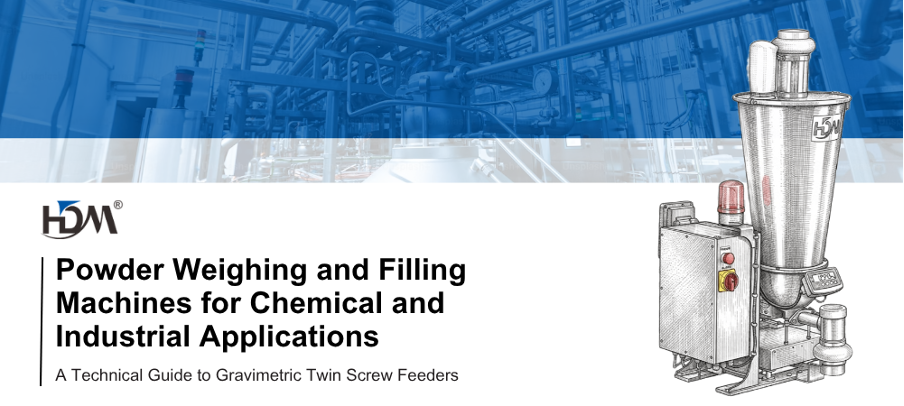
Why Chemical Process Applications Demand a Different Approach to Powder Dosing
Packaging filling machines operate batch-by-batch: each cycle fills one container, the operator checks weight, and the line moves on. Errors are caught at the fill station. In a continuous chemical process — a twin-screw compounding extruder running at 600 rpm, a polymerization line, a battery electrode slurry system — there is no fill-station checkpoint. A dosing error at the feeder propagates directly into the product.
Chemical powders present a specific set of challenges that standard volumetric filling equipment is not built to handle:
- Carbon black and pigments are highly cohesive and prone to aeration — bulk density can vary by 30–50% depending on handling history. Feedability still depends on the specific grade: oil-treated or high-viscosity carbon black and pigments can bridge severely enough that even a twin screw system needs a material trial before the model is finalized.
- Color masterbatch and fine additives bridge easily at low feed rates, causing intermittent starvation of the extruder feed throat.
- Catalysts and fine chemical powders often require sub-1% ratio accuracy to maintain reaction yield and product specification.
- Electrode powders for lithium batteries are ultra-fine, sensitive to segregation, and must be dosed continuously without pulsation.
A volumetric feeder — one that counts screw rotations to estimate volume — assumes bulk density is constant. In chemical processing, that assumption fails regularly. The result is off-spec product, material waste, and unplanned downtime.
How a Gravimetric Loss-in-Weight Feeder Works
A loss-in-weight feeder places the entire hopper and feeding mechanism on precision load cells. The controller monitors the rate at which the total assembly weight decreases — that rate is the actual feed rate in real time. A PID control loop continuously adjusts screw speed to maintain the target feed rate, regardless of what the material is doing inside the hopper.
This closed-loop gravimetric control is what separates LIW feeders from volumetric systems:
- If bulk density drops mid-run (as carbon black aerates under vibration), the controller increases screw speed to compensate.
- If the powder compacts in the hopper and flow rate drops, the controller responds within milliseconds.
- Dosing accuracy of ±0.5% is maintained across the full operating range — not just at a single calibration point.
High Dream’s LIW feeders use a dual-loop feedback control system — combining gravimetric (weight-based) and tachometric (speed-based) feedback — managed through a 7-inch touchscreen controller.
Why Twin Screw Configuration Is the Standard for Difficult Chemical Powders
Not all loss-in-weight feeders are configured the same way. The feeding element inside the LIW feeder — twin screw, single screw, vibratory tray, or belt — determines whether the system can actually handle your material reliably.
For the powders most common in chemical processing, twin screw is the default recommendation. The counter-rotating, interlocking screws continuously agitate material at the outlet, preventing the bridging and arching that causes single-screw systems to stall on cohesive materials. High Dream’s twin screw models include a dedicated anti-bridging agitator specifically designed for chemical industry feed rates and material characteristics.
| Twin Screw LIW Feeder | Single Screw LIW Feeder | |
| Best suited for | Cohesive, sticky, hygroscopic, hard-to-flow powders | Free-flowing granules and powders |
| Discharge consistency | High — counter-rotating screws continuously agitate material, preventing bridging | Good for easy-flowing materials |
| Anti-bridging | Built-in — interlocking screw flight geometry breaks apart clumps at the outlet | Limited — relies on material flowability |
| Typical chemical materials | Carbon black, pigments, color masterbatch, fine additives, catalyst powders, electrode materials | Plastic pellets, granular additives, salt, sugar |
| High Dream model | Micro-flow / Standard / Large-flow Twin Screw | Single Screw Series |
High Dream's twin screw LIW feeder line uses dual servo motor drives, allowing independent adjustment of screw speed and agitation frequency. This matters for materials like carbon black where the optimal agitation intensity is not simply proportional to the feed rate.
Chemical Industry Application Scenarios
Material characteristics determine machine configuration. The table below maps the most common chemical and industrial powder applications to the appropriate High Dream twin screw model.
| Industry | Material Example | Key Challenge | Why Twin Screw LIW | High Dream Model |
| Plastics Compounding | Carbon black, color masterbatch, pigments | Highly cohesive, abrasive, aeration-prone | Counter-rotating screws prevent carbon black agglomeration; dual servo maintains ratio accuracy | Standard / Large-flow Twin Screw |
| Chemical Processing | Catalysts, fine chemical powders, flame retardants | Variable bulk density, bridging risk, precision ratio control | Gravimetric closed-loop control compensates for density shifts in real time | Standard Twin Screw |
| Lithium Battery | Electrode powders (cathode/anode materials) | Ultra-fine particles, sensitive to segregation, continuous dosing required | Stable micro-flow discharge prevents segregation; servo precision meets battery-grade tolerances | Micro-flow / Standard Twin Screw |
| Coatings & Pigments | TiO₂, organic pigments, filler powders | Electrostatic, fine particle, density variation | Consistent low-rate discharge without over-compaction; maintains color-to-resin ratio | Micro-flow / Standard Twin Screw |
| Polyethylene / Polypropylene Granulation | PE/PP powder, additives | Large-scale throughput, multi-component ratios | High Dream LIW used in large-scale PE/PP polymerization and granulation lines | Large-flow Twin Screw |

Key Specifications to Evaluate When Sourcing a Gravimetric Feeder for Chemical Applications
Chemical applications impose requirements that are often stricter — or simply different — from food-grade specifications. Supplier datasheets are not always explicit about these differences. Use this checklist when evaluating equipment:
| Specification | What to Ask / What to Look For |
| Dosing accuracy | Request ±% of set point at your actual operating feed rate — not just peak accuracy. High Dream's LIW feeders are rated at ±0.5% adjusted feeding. |
| Feed rate range | Match the feeder's rated range to your process requirement. Oversizing causes accuracy loss at low feed rates. High Dream's range: from 100 g/h (micro-flow) to 1,000 kg/h (large-flow). |
| Material contact surfaces | Chemical applications may require corrosion-resistant alloys beyond standard SUS 304/316. Confirm material compatibility with your specific powder (abrasive, reactive, hygroscopic). |
| Hopper design | Mass-flow hopper geometry (steep walls, no dead zones) combined with anti-bridging agitation is critical for cohesive chemical powders. High Dream's chemical-grade models include dedicated arch-breaking devices. |
| Control system integration | Verify support for Modbus, Profibus, or EtherNet/IP for PLC/SCADA integration. Multi-feeder synchronization is essential for multi-component compounding lines. |
| Drive system | Dual servo motor drives allow independent control of screw speed and agitation frequency — important for materials where agitation intensity needs to differ from feed rate. |
High Dream's Twin Screw Loss-in-Weight Feeder Line
High Dream offers three twin screw LIW feeder models sized to match different chemical process requirements. Selecting the right model matters: an oversized feeder running at the low end of its range loses accuracy; an undersized one cannot meet throughput.
Micro-flow Twin Screw Loss-in-Weight Feeder
Designed for precision micro-dosing of fine powders where feed rates are low and accuracy is critical. Suitable for high-value additives, colorants, and specialty chemical powders where even small ratio deviations affect product quality.
→ Micro-flow Twin Screw Type
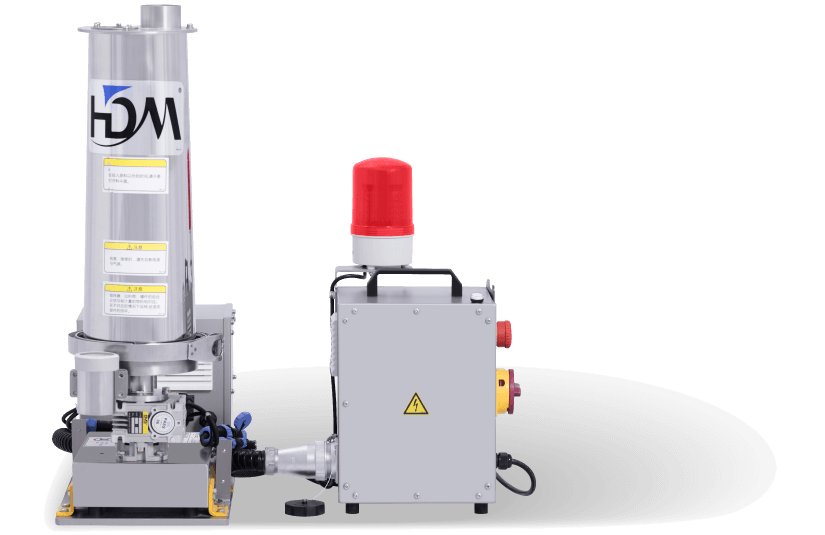
Standard Twin Screw Loss-in-Weight Feeder
The most widely deployed model in the lineup — handles the broadest range of chemical powder types at mid-range production volumes. The recommended starting point for most plastics compounding, chemical processing, and pigment dosing applications. Dual servo drives provide independent control of screw and agitation.
→ Twin Screw Type (Standard)
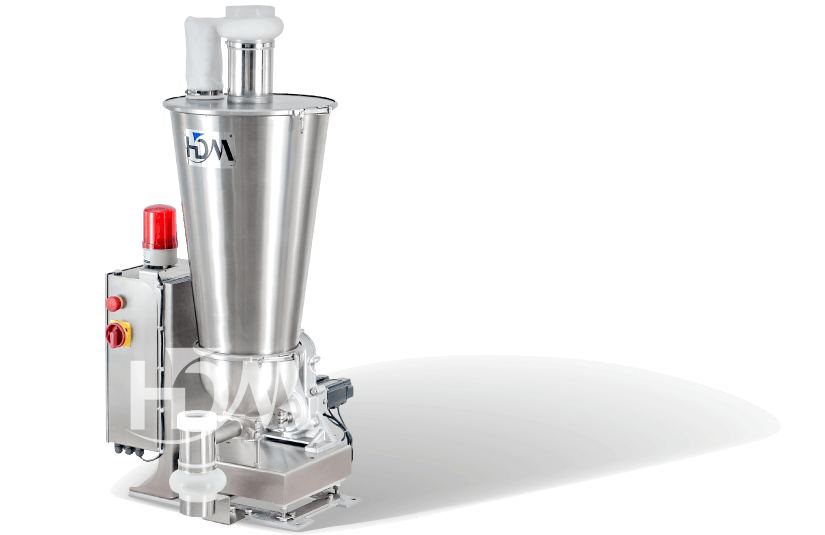
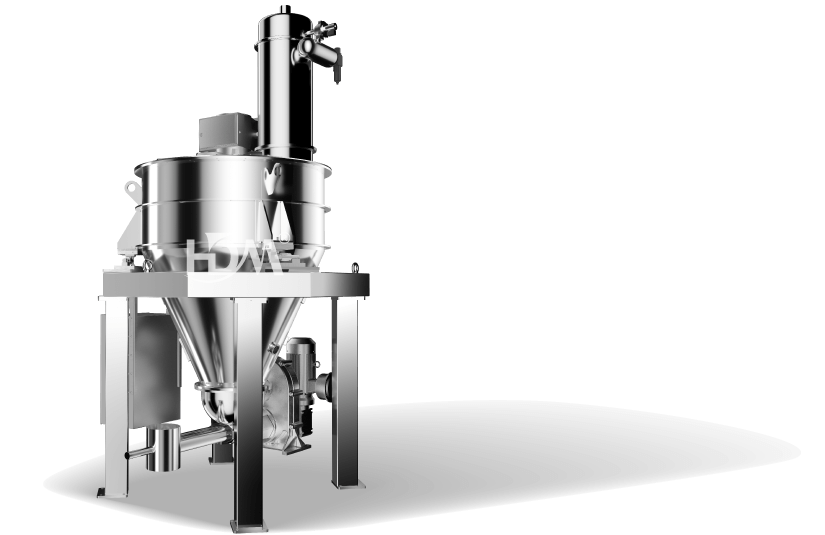
Large-flow Twin Screw Loss-in-Weight Feeder
Built for high-throughput industrial applications. Maximum flow rate reaches 1,000 kg/h with documented stability and accuracy. Applied in large-scale PE/PP polymerization and granulation lines, multi-layer sheet and pipe extrusion, and high-volume chemical compounding. The design incorporates arch-breaking devices to address the bridging tendency of chemical powders at high feed rates.
→ Large-flow Twin Screw Feeder
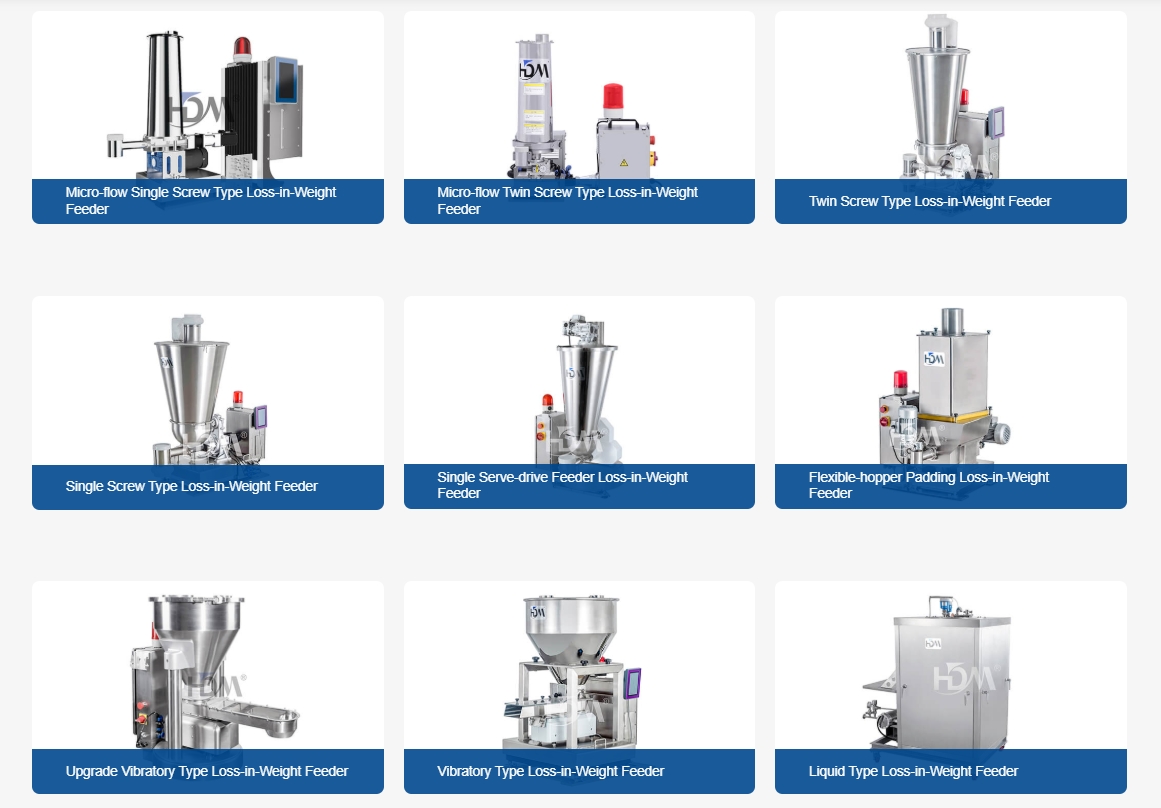
The complete Loss-in-Weight Feeder range — including single screw, vibratory, belt, and liquid models — is available at:
→ High Dream Loss-In-Weight Feeder Series
FAQ: Gravimetric Twin Screw Feeders for Chemical Powder Applications
These are the questions most commonly raised by process engineers and procurement teams evaluating precision powder dosing equipment for chemical and industrial applications.
Q1: What is the difference between a gravimetric loss-in-weight feeder and a volumetric powder filling machine?
A volumetric powder filling machine (including auger fillers) estimates feed quantity by counting screw rotations — it assumes bulk density is constant. A gravimetric loss-in-weight feeder continuously measures actual weight loss from the hopper and uses a closed-loop PID controller to maintain the target feed rate in real time. When bulk density shifts — as it regularly does with chemical powders like carbon black and pigments — a volumetric machine drifts out of spec. A gravimetric feeder corrects automatically, maintaining ±0.5% accuracy across the operating range.
Q2: Why do chemical powders like carbon black and color masterbatch require twin screw rather than single screw?
Carbon black, pigments, and fine additives are cohesive — they pack together, aerate unpredictably, and bridge across outlet openings. A single screw cannot reliably clear this bridging, especially at low feed rates. Counter-rotating twin screws continuously agitate the material at the outlet, breaking apart clumps and preventing arch formation. This is why twin screw is the standard configuration for difficult chemical powders, and why High Dream's chemical-grade models include dedicated arch-breaking devices in addition to the twin screw mechanism. That said, feedability still varies by grade — oil-treated or high-viscosity carbon black and pigments can bridge severely enough to challenge even a twin screw design, so we recommend a feed trial with the actual material before specifying a model.
Q3: What dosing accuracy can be expected from a twin screw LIW feeder on a chemical compounding line?
High Dream's LIW feeders are rated at ±0.5% adjusted feeding accuracy. At high extruder speeds (600–1,000 rpm), short-term accuracy during the feeder refill transition becomes critical — feeders with poor refill management can introduce torque surges that shut down the line. High Dream's automatic refill logic is designed to minimize this transition period.
Q4: How do I select the right High Dream twin screw model for my application?
The primary variables are feed rate range and material type. Matching the feeder's rated range to your actual operating range is essential — running an oversized feeder at the low end of its range degrades accuracy because the screw runs too slowly for precise control. High Dream recommends pre-testing with your actual material before final model selection. Contact High Dream's engineering team with your material characteristics, target feed rate, and process requirements for a specific recommendation.
Q5: Can a loss-in-weight feeder be integrated into an existing PLC or SCADA system?
Yes. High Dream's LIW feeders communicate via standard industrial protocols including Modbus, with the option to support Profibus and EtherNet/IP depending on the model configuration. The 7-inch touchscreen controller supports recipe storage and remote parameter management, which is essential for compounding lines running multiple formulations.
Specifying the Right Powder Dosing System for Chemical and Industrial Applications
The term "powder weighing and filling machine" covers a wide range of equipment, but for chemical process applications — continuous compounding, multi-component dosing, high-precision ratio control — gravimetric loss-in-weight feeding is the applicable technology. Volumetric filling equipment is not designed for the density variability and bridging behavior of chemical powders, and dosing errors in a continuous process cannot be caught and corrected at a downstream fill station.
Selecting the right LIW feeder model requires matching feed rate range, material characteristics, and process requirements. High Dream's engineering team works with customers on pre-testing with actual materials before finalizing equipment specifications.
Specifying a twin screw loss-in-weight feeder for your chemical or industrial process?
Tell us your material, target feed rate, and process requirements — High Dream's engineering team will advise on the right configuration and arrange material pre-testing. Contact High Dream
Related Products & Resources
-
Loss-In-Weight Feeder Series:
https://www.highdream-machinery.com/en/subcategory/Loss-In-Weight-Feeder.html -
Micro-flow Twin Screw:
https://www.highdream-machinery.com/en/product/Micro-flow-Twin-Screw-Type.html -
Standard Twin Screw:
https://www.highdream-machinery.com/en/product/Twin-Screw-Type.html -
Large-flow Twin Screw:
https://www.highdream-machinery.com/en/product/Large-flow-Twin-Screw-Feeder.html -
Checkweigher Series:
https://www.highdream-machinery.com/en/subcategory/Checkweigher.html